The hip is one of the largest and most complex joints in the body. It bears the full weight of the upper body while allowing a wide range of motion, and when something goes wrong – whether from wear and tear, injury, nerve irritation, or inflammation – the pain can be debilitating. It can interfere with walking, sitting, sleeping, and even standing still.
At our Bellevue, WA clinic, Dr. Attaman evaluates and treats the full spectrum of hip pain using minimally invasive, non-surgical, image-guided procedures. He will identify the precise source of your pain before recommending any treatment. Book a clinic appointment or schedule a telemedicine consultation to discuss your hip pain.
What causes hip pain?
Hip pain is not a single condition, but rather a symptom with many possible sources. Common causes include:
- Osteoarthritis of the hip joint
- Trochanteric bursitis (outer hip pain from irritation of the fluid-filled sac on the bony point of the hip)
- Hip labral tears
- Gluteal tendinopathy (irritation of the tendons that attach the gluteal muscles to the hip)
- Sacroiliac joint dysfunction
- Iliopsoas tendinitis or bursitis
- Femoral nerve irritation
- Referred pain from the lumbar spine
- Hamstring or adductor tendinopathy
- Post-surgical hip pain
By the way, what feels like hip pain can sometimes originate in the lower back, the sacroiliac joint, or surrounding soft tissues. Conversely, what appears to be a spine problem can sometimes be the hip. Dr. Attaman’s thorough diagnostic process ensures your treatment is aimed at the correct source.
What are the symptoms of hip pain?
Hip pain can present very differently depending on the underlying cause. Some patients feel it deep inside the groin; others experience it on the outer hip, buttock, or down the thigh. Common symptoms include:
- Deep aching or sharp pain in the groin, often from the hip joint itself or the labrum
- Pain on the outer hip or thigh, especially when lying on that side – a common sign of bursitis or gluteal tendinopathy
- Buttock pain, which may point to sacroiliac joint dysfunction, piriformis syndrome, or hamstring tendinopathy
- Discomfort when walking, climbing stairs, getting up from a chair, or bearing weight
- Night pain that disrupts sleep, particularly when lying on the affected side
- Stiffness or reduced range of motion, such as difficulty putting on shoes or rotating the leg
Treatment options for hip pain
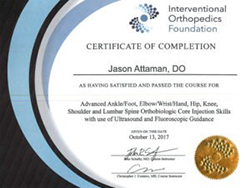
Dr. Attaman is certified at the highest level by the Interventional Orthopedics Foundation, with advanced training in orthobiologic and interventional procedures targeting the hip. All injections are performed under fluoroscopic (X-ray) or ultrasound guidance for maximum precision and safety.
Hip joint injections
Intra-articular hip injections deliver medication precisely inside the joint capsule under fluoroscopic or ultrasound guidance. These can provide significant relief for arthritis, labral irritation, and general joint inflammation. Joint injections are often combined with regenerative treatments for longer-lasting benefit.
Prolotherapy for hip pain
Prolotherapy uses carefully placed injections of a regenerative solution to stimulate the body’s healing processes in weakened or damaged ligaments and tendons around the hip. It is particularly useful for labral pathology, hip instability, and tendinopathy. Unlike cortisone, which can weaken tissues with repeated use, prolotherapy works with the body’s own repair mechanisms to strengthen damaged structures over time.
Shockwave therapy for hip pain
Shockwave therapy (ESWT) is highly effective for trochanteric bursitis, gluteal tendinopathies, and chronic outer hip pain. Using high-energy sound waves delivered through the skin, it promotes healing in damaged soft tissues, increases local blood flow, and stimulates the release of growth factors — all without needles or downtime. Dr. Attaman uses both focused and radial shockwave devices manufactured in Germany and Switzerland. A typical course involves 5–6 sessions.
Pulsed radiofrequency treatment (PRF) for hip pain
Pulsed radiofrequency (PRF) can be applied to the nerves supplying the hip joint — including the femoral nerve and articular branches — to interrupt chronic pain signals without destroying nerve tissue. It offers a longer duration of relief than conventional nerve blocks and is well-suited for patients with persistent hip pain that has not fully responded to other treatments.
Trochanteric bursa and tendon injections
Dr. Attaman is certified in ultrasound-guided injections to all surfaces of the greater trochanter, the gluteal tendons, and surrounding soft tissues. These targeted injections can precisely address the source of lateral hip and buttock pain. Depending on the clinical picture, regenerative treatments may be used alongside or instead of conventional anti-inflammatory agents.
Sacroiliac joint therapy
When hip-region pain originates from the sacroiliac joint – a common and frequently missed source – Dr. Attaman offers targeted SI joint injections and radiofrequency lesioning to provide lasting relief. Learn more about sacroiliitis treatment.
FAQs
How do you know if your hip pain requires surgery?
Many causes of hip pain – including bursitis, tendinopathy, arthritis, and even some labral issues – respond well to non-surgical treatment. Dr. Attaman will thoroughly evaluate your imaging, symptoms, and prior treatment history to determine whether interventional options are likely to help. If surgery is ultimately the right choice, he will refer you to one of the top hip surgeons in the Pacific Northwest. We have built a strong network of outstanding surgical colleagues over the past decade.
What is the difference between prolotherapy and a cortisone injection?
Cortisone is an anti-inflammatory steroid that can quickly reduce pain, but it does not promote healing, and repeated cortisone injections can actually weaken tissues over time and worsen joint arthritis. Prolotherapy, by contrast, uses a regenerative solution designed to stimulate the body’s own repair process, with the goal of strengthening and healing damaged structures for longer-lasting results.
Do you offer telemedicine consultations for hip pain?
Yes. Telemedicine appointments are a great way to discuss your history, review your records and prior imaging, and understand what treatment options may be appropriate before traveling to the Bellevue clinic for an in-person procedure. Dr. Attaman sees patients from across Washington state, and we also welcome patients traveling from out of state or from Canada.
Book an appointment for hip pain treatment
Dr. Attaman personally evaluates every patient and personally performs every procedure. Our Bellevue, WA clinic is open Tuesday through Saturday, including Saturdays, making us the only pain and musculoskeletal clinic in Washington (that we know of) with Saturday hours.
Click here to request a clinic appointment or a telemedicine consultation. You can also reach us at (425) 247-3359 or (206) 395-4422.
About the Author: Phil Rozek