Dr. Jason Attaman offers stellate ganglion block treatment (SGB) to patients for loss of smell or loss of taste following a COVID diagnosis. Often an effective treatment option for PTSD and anxiety, and in some cases for pain associated with traumatic head injuries or post-ICU trauma, SGB may also help restore olfactory and gustatory senses after COVID.
The treatment process is generally the same in SGB for loss of smell or loss of taste as it is in other applications: SGB is purely a medical procedure, it is fast-acting, and it only requires two visits to the clinic.
Research by the NIH has shown SGB to be a promising treatment option for people who have suffered from COVID and generally recovered otherwise, but whose senses of smell or taste don’t seem to be as strong, or seem to have been altered dramatically, even months after recovering from other symptoms. As you may know, the two senses are interlinked, in that one’s perception of taste largely depends on one’s ability to smell.
Dr. Attaman’s office is in Bellevue, WA. We – Dr. Attaman and Dr. Cameron Cartier – have performed SGB treatments for patients from all over the US and Canada (the clinic is easily accessible from British Columbia and Alberta). We offer a telemedicine consultation to verify that you are a good candidate for these injections. Patients can stay overnight in Bellevue, Washington, and have the treatment completed over 2 days.
We offer a substantial discount to US Military veterans, active-duty personnel, and law enforcement. Many of our patients come from nearby Joint Base Lewis-McChord. Dr. Cartier is a USAF veteran.
Contact us today to schedule a telemedicine consultation, or read on to find out more about stellate ganglion block as a possible treatment option for symptoms of post-COVID loss of smell or taste.
Our SGB Experience
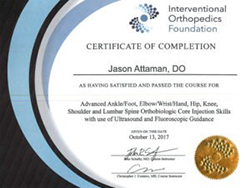
Dr. Attaman has performed SGB procedures since 2007 for a variety of conditions. He was elected as a Seattle Magazine “Top Doc” in Pain Medicine for 2019, 2022, 2023, and 2024. He was elected by other physicians as a Seattle Met “Top Doc” in Pain Medicine for 2015, 2016, 2017, 2018, 2019, 2020, and 2021.
What is a Stellate Ganglion Block (SGB)?
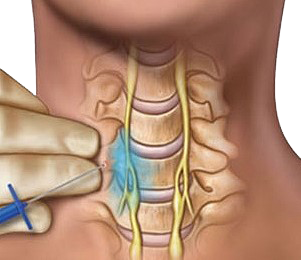
The stellate ganglion is a bundle of nerves that is located deep in the lower neck. It is located within the cervical sympathetic chain. Sympathetic nerves play a strong role in our fight-or-flight response. When you have trauma symptoms commonly associated with a stay in the ICU, these nerves malfunction and are constantly sending distress signals to your brain and body. Injecting local anesthetic (numbing medicine) around these nerves is called a stellate ganglion block (SGB). SGB resets these nerves that are chronically in fight-or-flight response. This is similar to rebooting your computer; after the “SGB reboot,” your nerves function normally. For safety reasons, stellate ganglion block (SGB) injections need to be performed under either ultrasound and/or fluoroscopic guidance as there are major blood vessels and organs nearby. The SGB injection is not new and has been used for 100 years to treat painful conditions such as chronic regional pain syndrome (CRPS) of the upper extremity.
The only physicians formally trained in the SGB procedure are Interventional Pain Management physicians (MDs and DOs). We learn how to perform SGB safely during a year-long advanced training program called a Pain Medicine fellowship. A fellowship is the highest level of training a physician can complete and is done after four years of medical school, one year of internship, and three years of residency. Stellate ganglion block is a technically demanding procedure that requires precise image guidance using an ultrasound machine and sometimes a form of x-ray called a fluoroscope. We always prefer to use ultrasound as it allows us to better visualize nerves, arteries and veins in this delicate area.
The Stellate Ganglion Block (SGB) Procedure
You may wonder why some physicians use ultrasound while others use fluoroscopy. The answer is fairly simple; it is much safer and accurate to use ultrasound but much more difficult to learn this method. Fluoroscopy is faster but does not allow for the visualization of delicate nerves and blood vessels in the area. The procedure is not painful, as it involves only two needle pokes in the side of the neck after numbing the skin. Typically, we will first perform the SGB on the right side of your neck, as medical studies have found the right side to be most efficacious in most people. We closely follow Dr. Sean Mulvaney’s updated protocols. His latest research indicates better outcomes when:
- The procedure is performed at TWO levels. We typically inject at the C6 and C4 levels, depending on each patient’s individual anatomy. Some doctors refer to this advanced method as a “dual sympathetic reset” (DSR).
- This double injection procedure is performed on BOTH sides of the neck. Each side is done at least 24 hours apart, but sometimes is performed one week apart, depending on scheduling availability.
We will typically schedule a right SGB followed by a left SGB on a subsequent day to ensure that you have the best opportunity for optimal outcomes. For safety reasons, we do not treat both sides on the same day. In our clinic, we have top of the line ultrasound machines and fluoroscopy available. With rare exceptions, we prefer to perform this procedure under ultrasound guidance.
Be careful; you may find professionals such as naturopathic physicians (NDs) or nurse practitioners (ARNPs or DNPs) offering this procedure. They are unqualified to perform this procedure. They will do their best to hide their lack of training in interventional pain management procedures from you. These professionals complete no formal hospital-based residency nor fellowship in performing pain management procedures. It is dangerous for NDs or NPs to attempt to perform complex interventional procedures such as a stellate ganglion block. If you are looking for a professional to perform this procedure on you, be sure they are a physician (MD or DO) and have completed medical school, internship, formal hospital-based residency and especially a one year long accredited Pain Medicine fellowship. Some physicians with Sports Medicine fellowship training are also qualified to do this procedure. You can check if your physician is a board certified physician at the American Board of Medical Specialties website. Only then are they qualified to safely perform this procedure.
Is stellate ganglion block covered by health insurance?
Your initial consultation and follow-up exams are covered by most insurances. However, the SGB procedure itself is not covered by insurance when used to treat post-COVID losses of sense.
About the Author: Phil Rozek